

Introduction
Type “build me a nice website” into an AI builder and you’ll get exactly what that sentence deserves: something generic.
The perfect AI website builder prompt includes five specific things: your business type, your target audience, your primary goal, your preferred style, and the exact pages or features you need.
Miss any one of these and the AI fills the gap with a guess. Include all five and the result feels like it was built specifically for you, because it was.
This guide walks through what an AI prompt actually is, the five elements every strong prompt needs, real examples for both brochure and e-commerce sites, the mistakes that quietly sabotage most first attempts, and how to refine your site once the AI has done its first pass.
What an AI Website Prompt Actually Is
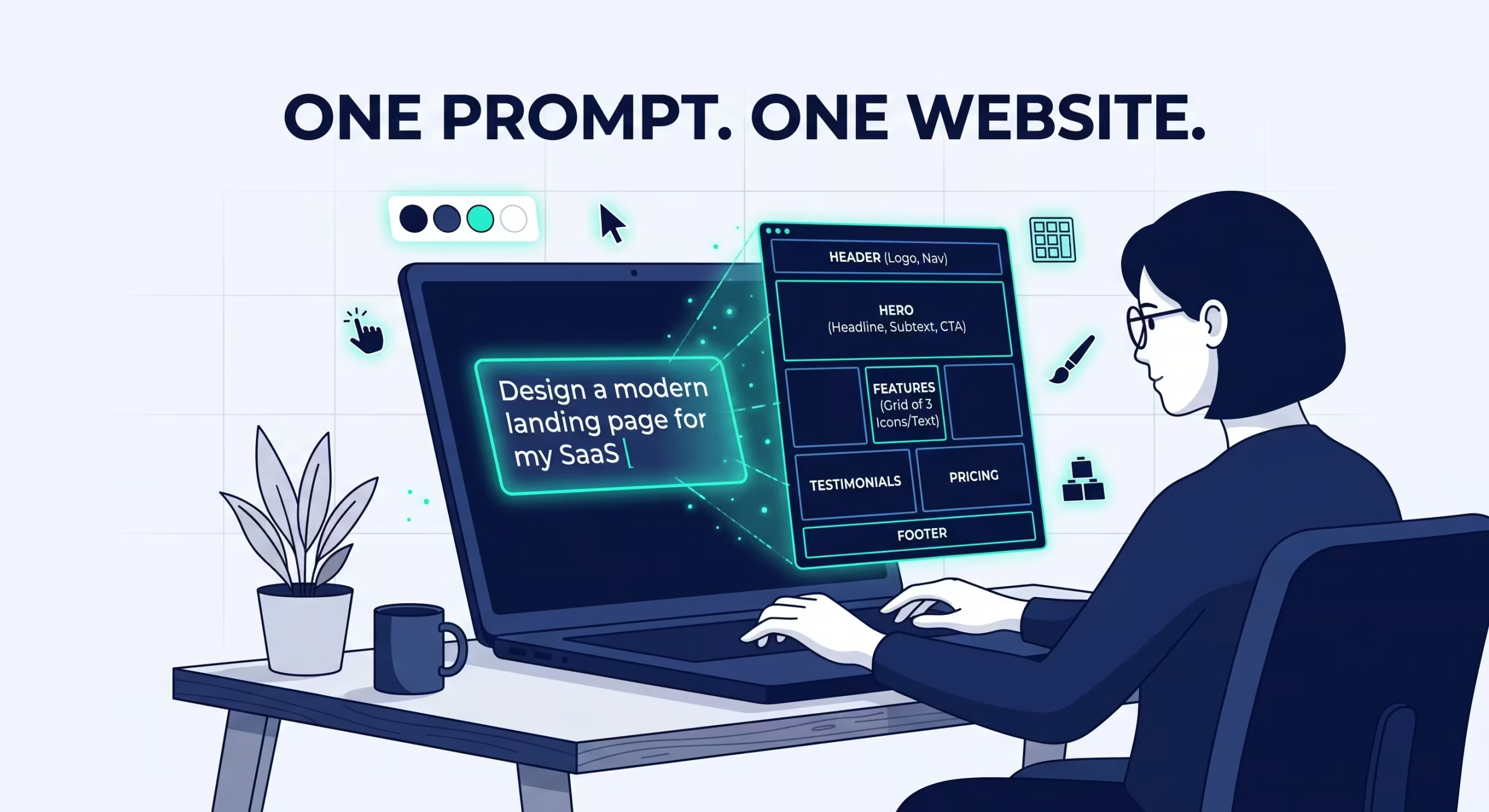
When you build a site with an AI website builder, there’s no dragging templates around or wrestling with a page builder plugin. You describe the website you want in plain language, and the AI constructs it in minutes. That description is your prompt, and it functions exactly like a brief you’d hand to a human designer.
The comparison matters because it reframes how people approach the tool. A designer who receives “make me a nice website” produces something safe and forgettable. A designer who receives a clear brief covering the business, the audience, and the goal produces something that actually fits. AI builders work the same way. The difference is speed: instead of a week-long back and forth, you get a working draft in minutes and refine from there.
Small businesses have driven much of the growth in AI-powered website building, largely because it offers professional results without the cost or timeline of a traditional build. But speed only helps if the output is usable, and usability starts with the quality of the prompt, not the sophistication of the tool.
Core Insights: The Five Elements of a Strong Prompt
Your Business Type and Industry
Vague inputs produce vague outputs. Instead of “a shop,” describe the specific business: a family-run bakery, a boutique HR consultancy, an independent skincare brand. Specificity here shapes everything downstream, from tone of voice to layout conventions the AI assumes are relevant.
Your Target Audience
A B2B software company targeting operations managers needs a fundamentally different site to a yoga studio targeting local parents. Naming your audience directly, including age range, role, or motivation, lets the AI calibrate language and visual tone accordingly.
Your Primary Goal
Every layout decision, from button placement to which section sits above the fold, should trace back to one answer: what do you want a visitor to do? Book a call, buy a product, download a resource, or fill in a form. State it plainly and the AI can build toward it.
Your Style and Brand Feel
Reference colours, moods, or even websites you admire. Phrases like “clean and minimal,” “bold and confident,” or “warm and approachable” give the AI real creative direction rather than leaving tone entirely to chance.
Your Required Pages and Features
List exactly what you need. A homepage and a contact page is the floor, not the ceiling. Do you need a services page, a portfolio, a product catalogue, or a booking system? State it clearly rather than assuming it’s obvious.
Real-World Application: Prompts by Website Type
Brochure Websites
A brochure website is a digital storefront: its job is to explain who you are, what you offer, and why someone should get in touch. This format suits service businesses, trades, professional practices, and freelancers particularly well.
A strong brochure prompt leads with location, since local SEO depends on it, and names trust signals explicitly rather than expecting the AI to invent them. For example: “Create a professional, trustworthy website for a family-run plumbing company in Leeds with 15 years of experience. Target audience: homeowners across West Yorkshire. Primary goal: get visitors to call or request a free quote. Pages needed: Home, Services, About, Testimonials, Contact. Brand feel: reliable, local, established. Colours: navy and white with a yellow accent.”
Notice how the prompt states the single most important action (call or request a quote) rather than listing five competing goals. That clarity is what keeps the resulting site focused.
E-commerce Websites
E-commerce prompts carry more weight because the stakes are higher. Every element, from product page layout to checkout flow, exists to move a visitor from browsing to buying. A strong e-commerce prompt covers what you sell, how you sell it (one-off, subscription, bundles), who buys from it, your visual identity, and the trust signals that overcome common objections like price or fit.
For example: “Create a premium e-commerce website for a small-batch skincare brand selling natural face oils to women aged 28 to 45 who prioritise clean beauty. Primary goal: drive sales and build an email list. Features needed: filtering by skin type, a bundle builder, an email capture popup with a first-order discount, and reviews on every product page. Brand feel: spa-like, earthy, luxurious. Colours: warm off-white, sage green, terracotta.”
The features list matters as much as the aesthetic direction here. Naming a bundle builder or a reviews section tells the AI to structure the catalogue and product pages around those mechanics from the outset, rather than bolting them on later.
Common Mistakes That Undercut a Good Prompt
Even experienced users fall into a handful of predictable traps. Being too vague leaves the AI to make generic assumptions about tone and layout. Omitting location quietly forfeits local SEO opportunities that would otherwise strengthen the site. Leaving out a call to action produces a site that looks fine but converts poorly, because no section has a clear job to do.
Listing every possible feature at once, without prioritising, tends to overwhelm the output rather than sharpen it. It’s better to lead with the single most important goal and layer in supporting features afterward. Forgetting to mention mobile optimisation is another common oversight, given that most visitors now browse on their phones first.
Finally, treating the first generation as final is perhaps the biggest missed opportunity. The first draft is a starting point, not a finished product, and refining it is where the real quality gains happen.
Why This Matters in the AI Era
Search behaviour is shifting toward AI-generated overviews and direct answers, which means a website’s underlying structure and clarity matter as much as its visual polish. A site built from a well-structured prompt tends to arrive with cleaner information architecture from day one, which supports both conventional SEO and newer practices like Answer Engine Optimisation, where AI systems pull directly from well-organised content to answer user queries.
As AI website builders become the default starting point for small businesses, the sites that stand out won’t be the ones built on the flashiest platform. They’ll be the ones built on prompts that communicate a real business, a defined audience, and a specific goal, refined thoughtfully rather than accepted as-is. Prompt writing is becoming a genuine business skill in its own right, and the businesses that treat it seriously now will have a real head start.